31 Oct 2026 · @Annette
Long before plastic pumpkins and shop-bought costumes, Scots were marking the last night of October with bonfires, carved turnips and children in disguise. Much of what the world now calls Halloween has roots right here, and our ancestors would recognise more of it than you might think.
For family historians, these customs are more than seasonal fun. They are a window into how our forebears saw the world: a place where the line between the living and the dead could grow thin, where the harvest was gathered in before winter, and where a hazelnut on the fire might tell you who you were going to marry.
Samhain: where it all began
Samhain (in Scottish Gaelic, Samhainn, roughly “sow-in”) was the Celtic festival that closed the harvest and split the year into its light and dark halves. In Gaelic Scotland it fell on 1 November, with the celebrations beginning the night before, Oidhche Shamhna.
This was the night when the boundary between our world and the Otherworld was believed to weaken. Fairies and the spirits of the dead could cross over and walk among the living. Great bonfires, called samhnagan, were lit to keep evil at bay. On the islands neighbours competed to build the biggest blaze, while on the mainland fires were set on high ground to be seen for miles.
The Church later folded the festival into its own calendar. All Saints’ Day, or All Hallows, moved to 1 November, which made 31 October All Hallows’ Even: Hallowe’en. Scotland has written evidence of the night from at least the 16th century. In 1584 the poet Alexander Montgomerie described the fairy king and his court riding out on “alhallow even”.
Guising: Scotland’s original trick or treat
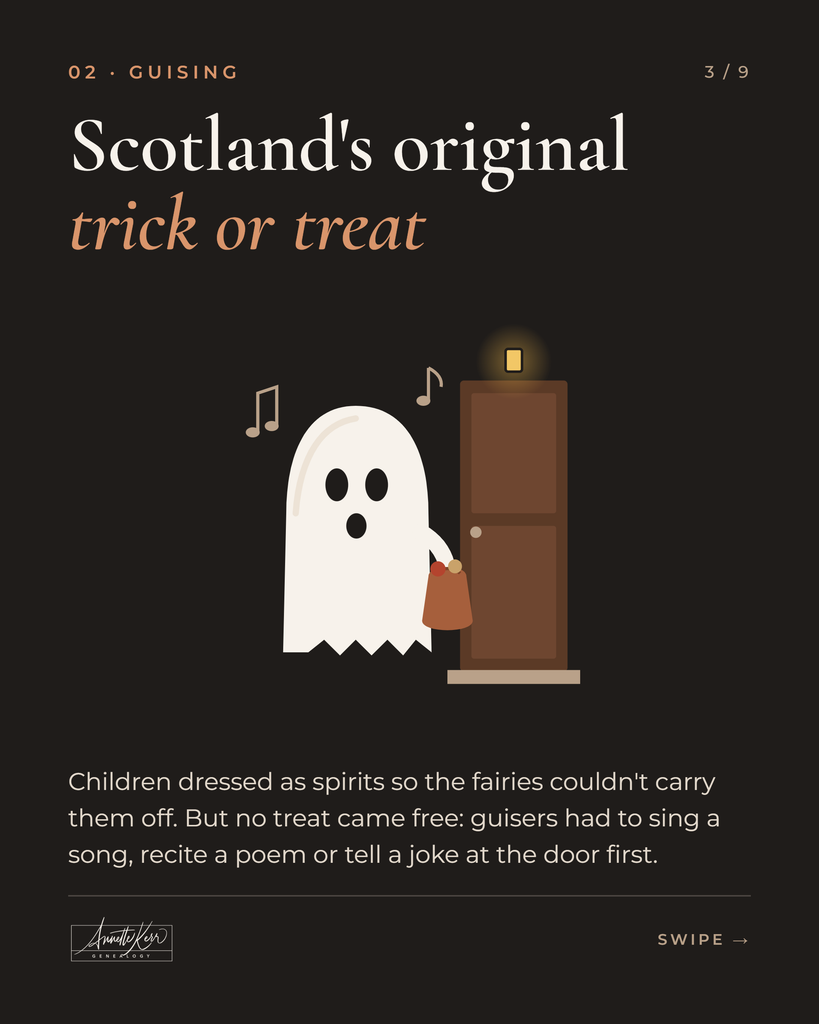
If you grew up in Scotland, you didn’t go trick-or-treating, you went guising. The name comes from “disguise”, and the disguise had a purpose. Dressed as spirits, children could blend in with whatever was wandering abroad that night and avoid being carried off by the fairies.
The treat had to be earned. Guisers sang a song, recited a poem or told a joke at the door before anyone handed over nuts, fruit or a few coins. Tradition even says King James V went guising in disguise around the villages near Stirling Castle.
Guising wasn’t always limited to one night. Early 20th-century newspapers suggest it could run for weeks, and that worried the authorities. The Children Act 1908 made it an offence to use children to beg. In 1929 the Aberdeen Press and Journal reported parents charged after their guisers stopped people in the street. The case was dismissed, and National Records of Scotland suggest the sheriff’s advice on when guising was acceptable may help explain why it became tied to 31 October.
Tumshie lanterns: before the pumpkin
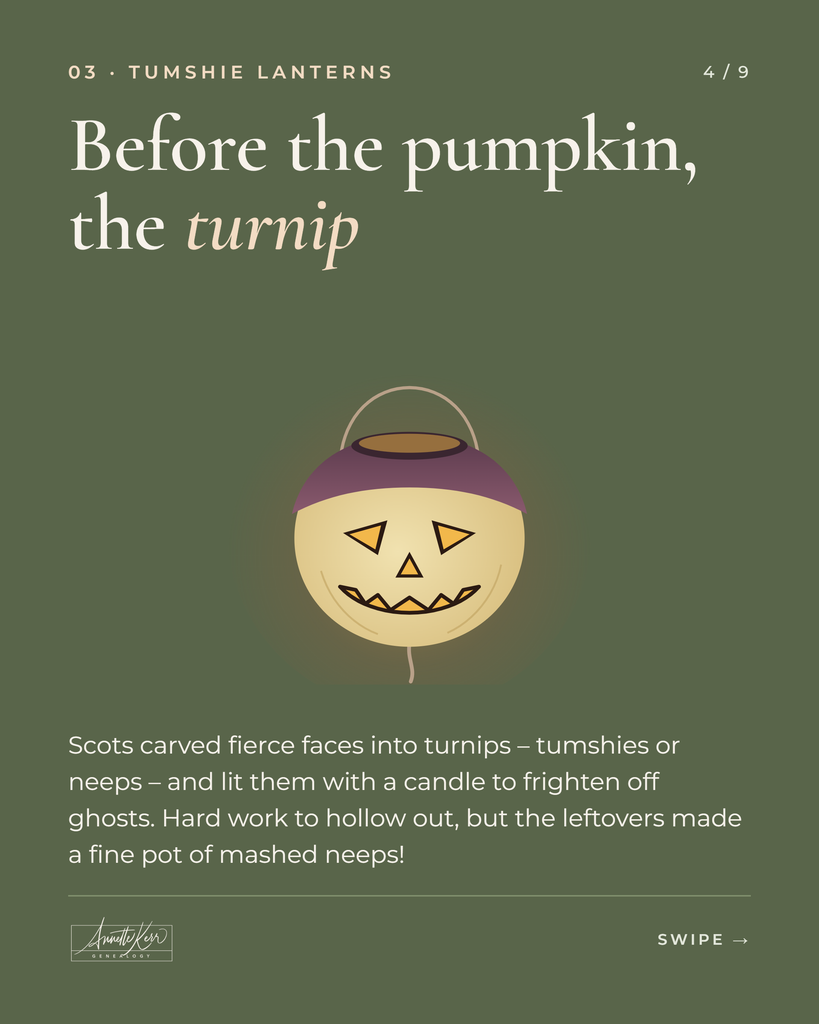
Forget pumpkins. A proper Scottish Hallowe’en lantern was carved from a turnip, or tumshie in Scots (neep is just as common). Faces were cut into the skin, the inside scooped out and a candle set within to frighten off fairies and ghosts.
Anyone who has tried it will tell you a turnip fights back. Hollowing one out takes patience, a strong spoon and sore hands. The reward is a wonderfully eerie, wizened glow, and a pot of mashed neeps from the leftovers. Scottish and Irish emigrants are generally credited with carrying the custom across the Atlantic, where the softer, bigger pumpkin took over and later made its way back to us.
Dooking for apples and treacle scones
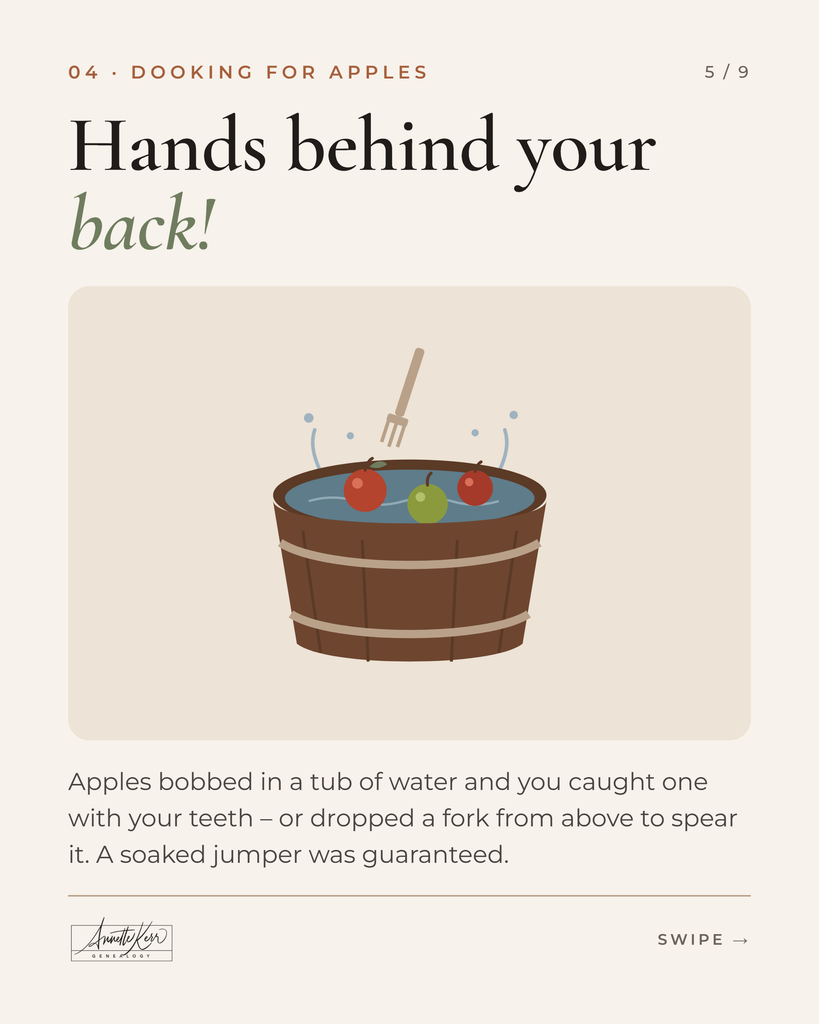
No Scottish Hallowe’en party was complete without a basin of water and a few apples bobbing on top. In apple dooking, you knelt with your hands behind your back and tried to catch one with your teeth. In some homes you held a fork in your mouth and dropped it from above to spear one. Expect a soaked jumper either way. The origins are hazy, with some links to the apple as a fruit of love and divination.
Then came the treacle scones. Scones were smeared with black treacle and hung from a string, often stretched across the room or from the pulley. With hands behind backs, players tried to take a bite as the scone swung past their faces. It was messy, sticky and enormously good fun, and many of us still remember the treacle in our hair.
Burns, nuts and kale: fortune-telling on Hallowe’en
For young Scots in the past, Hallowe’en was above all a night for discovering who you would marry. Robert Burns captured these customs in his poem Halloween, written in 1785 and published in the 1786 Kilmarnock edition. The 1787 Edinburgh edition added notes explaining the charms for readers who didn’t know them.
- Nut burning: A couple placed two hazelnuts in the fire. If they burned quietly side by side, a happy match lay ahead; if they hissed and jumped apart, trouble.
- Pulling kale: Eyes shut, you pulled a kale stalk from the yard after dark. Its height and shape foretold your future partner’s, and earth on the roots meant wealth.
- The apple and the mirror: Eat an apple before a looking glass and your future spouse might appear over your shoulder.
- Fuarag: In the Highlands, oatmeal and cream was mixed with hidden tokens. A ring meant marriage, a coin wealth, and a thimble another year single.
Finding Hallowe’en in your ancestors’ records
You can still catch glimpses of these customs in the sources we use every day. Here is where to look.
- Church court records: The Church of Scotland frowned on Hallowe’en fires. The Assembly of Fife in 1648 and Cupar Presbytery in 1649 told ministers to stop bonfires on the Sabbaths before Midsummer and Hallowe’en. Kirk session minutes, many searchable on ScotlandsPeople, sometimes record parishioners rebuked for “superstitious” practices.
- The Statistical Accounts: Parish ministers described local customs in the 1790s and 1830s. In 1793 the minister of Logierait, Perthshire, recorded Hallowe’en bonfires in his parish.
- Newspapers: Local papers reported Hallowe’en parties, dances and guising, and the occasional court case like the 1929 Aberdeen one.
- Photographs and memories: Family albums, local archives and oral history projects often hold pictures of turnip lanterns and dooking from the 20th century.
Why not ask your older relatives what they remember of Hallowe’en? Their stories of guising songs and treacle scones are family history too, and well worth writing down. Happy Hallowe’en!
References
- Historic Environment Scotland, Samhainn and the Scottish traditions of Hallowe’en (2023)
- National Records of Scotland, Out guising (2020)
- University of St Andrews Special Collections, ‘Alhallow Evin’ in Scotland (2019)
- National Trust for Scotland, 6 Scottish Halloween traditions
- Robert Burns, Halloween, in Poems, Chiefly in the Scottish Dialect (Kilmarnock, 1786)