On 2 October 1263, a storm‑damaged Norwegian fleet under King Håkon IV clashed with Scottish forces near Largs. Although often described as a “battle,” most historians see it as a series of small, inconclusive skirmishes rather than a decisive military engagement. But its consequences were enormous: it marked the beginning of the end of Norway’s 400‑year influence over the Hebrides and the Northern Isles. This week marks its 763rd anniversary.
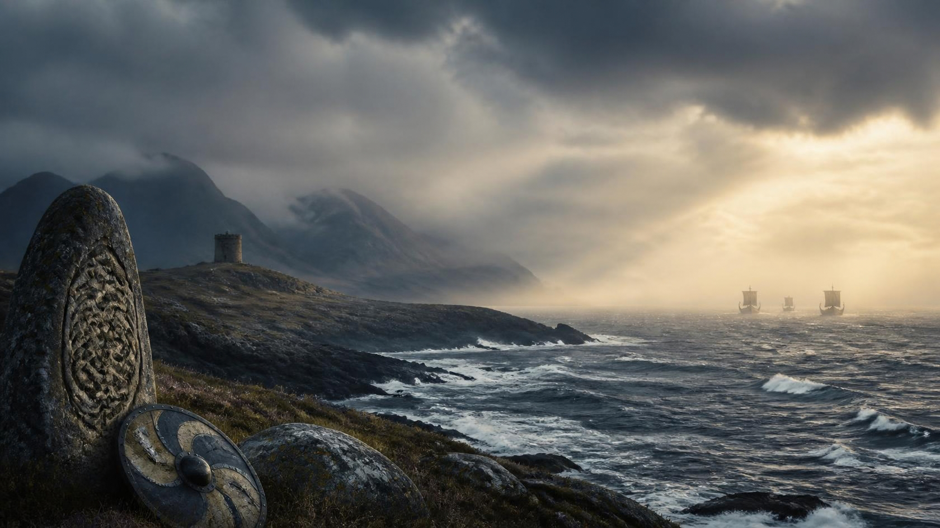
What actually happened at Largs?
- Håkon’s fleet had sailed from Norway to defend Norse control of the Isles.
- A violent storm scattered and damaged his ships, forcing some ashore at Largs.
- Alexander III’s forces, traditionally said to have been led by Alexander, High Steward of Scotland, engaged the stranded Norsemen in several brief clashes.
- The fighting was not decisive, but the weather and logistical strain forced Håkon to retreat north to Orkney.
- He died at the Bishop’s Palace in Kirkwall in December 1263, ending the campaign.
Why this moment changed the map of Scotland
After Håkon’s death:
- In 1264, Magnus Olafsson, King of Man, submitted to Alexander III.
- In 1266, Håkon’s successor Magnus VI signed the Treaty of Perth, formally ceding the Hebrides and the Isle of Man to Scotland in return for 4,000 merks and an annual payment of 100 merks.
- Only Orkney and Shetland remained under Norse control until 1468–69, when they were pledged to Scotland as security for the dowry of Margaret of Denmark, bride of James III.
This transfer ended Norwegian sovereignty over the Western Isles, but it did not erase the Norse past. Gaelicisation had long been underway, and the legacy of centuries of Norse settlement and intermarriage remained.
Why the Battle of Largs Matters for Genealogy Today
Although the battle itself was small, it marks the close of the Norse era in the Isles, and the four centuries of settlement before it left a lasting mark on the ancestry, surnames, DNA patterns, and place‑names of western and northern Scotland.
1. Norse DNA in the Hebrides & Northern Isles
Centuries of Norse settlement left a strong genetic footprint. Place-name evidence once led some scholars to argue that in places like Lewis, Norse settlement was so complete that the earlier Celtic population may have been entirely replaced. Genetic studies do not support total replacement: Norse ancestry is clearly present in the Western Isles, but most islanders’ ancestry remains predominantly local, and the strongest Scandinavian signal is found in Shetland and Orkney. In other islands, Norse–Gaelic intermarriage produced a mixed seafaring population.
This is why:
- People from Lewis, Harris, the Uists, Skye, and
- People from Orkney and Shetland
often show higher proportions of Scandinavian DNA compared to mainland Scots.
2. Norse‑origin surnames
Many surnames in the Isles and the far north have Norse roots, including:
- MacLeod (from Ljótr)
- MacAulay (from Óláfr; this applies to the Lewis MacAulays, as the Dunbartonshire MacAulays have a separate Gaelic origin)
- MacAskill (from Ásketill)
- MacIver (from Ívarr)
- MacCorquodale (from Þorketill)
- MacManus (from Magnús)
- Gunn (from Gunni, in Caithness and Sutherland)
- Manson (from Magnús) in Orkney and Shetland
- Isbister, Linklater, Flett: Orkney surnames taken from Norse farm-names
- Shetland patronymics: surnames stayed fluid into the 18th and 19th centuries, so Thomas Johnson’s son might be recorded as John Thomason. This matters when searching the records.
These surnames often appear in areas once under Norse rule.
3. Norse place‑names
Place‑name evidence is one of the strongest indicators of Norse settlement.
A scholarly analysis shows:[C1]
- Lewis: approx. 4 Norse names for every 1 Gaelic name
- Islay: 1 Norse to 2 Gaelic
- Arran: 1 Norse to 8 Gaelic
- Kintyre: 1 Norse to 4 Gaelic
Common Norse elements include:
- -staðir / -sta → “farm” (e.g., Tolsta and Mangersta in Lewis, Hosta in North Uist)
- -bólstaðr / -bost → “farm” (e.g., Shawbost, Leurbost, Carbost)
- -vik / -wick → “bay” (e.g., Lerwick, Wick)
- -fjord / -firth → “sea inlet”
- ey / ay → “island” (e.g., Orkney, Colonsay, Taransay, Pabbay, Barra)
These linguistic clues help genealogists map ancestral origins.
4. Clan histories shaped by Norse rule
Many clans trace their origins to Norse settlers or Norse‑Gaelic families, including:
- Clan MacLeod (traditionally linked to Norse ancestry)
- Clan MacDonald (Norse‑Gaelic Lords of the Isles; their ancestor Somerled bore the Norse name Sumarliði)
- Clan Gunn (Norse roots in Caithness)
- Clan Nicolson / MacNicol (claims Norse origins, Skye)
Understanding Norse influence helps genealogists interpret:
- migration patterns
- naming traditions
- clan territories
- DNA matches with Scandinavian clusters
How to Use This History in Your Genealogy Research
Check DNA ethnicity estimates
Look for:
- Norwegian
- Danish
- Swedish
- “Scandinavian”
- “Orkney/Shetland” clusters
- “Hebrides” clusters
These can reflect Norse ancestry, but treat them with caution. An ethnicity estimate can’t be dated to the Viking Age: a “Danish” or “Scandinavian” result may equally reflect Anglo-Saxon or Danelaw ancestry, or much older shared ancestry. Norway is the most relevant source for Scotland’s Vikings. For a direct paternal or maternal line, Y-DNA and mtDNA tests are more informative; a Y-DNA haplogroup such as R1a or I1 can hint at, but never prove, a Norse paternal line.
Study local place‑names
If your ancestors lived in areas with heavy Norse naming patterns, it is consistent with Norse heritage, though place-names show where Norse speakers settled rather than who your own ancestors were.
Explore clan histories
Many clans have documented Norse origins or Norse‑Gaelic founders.
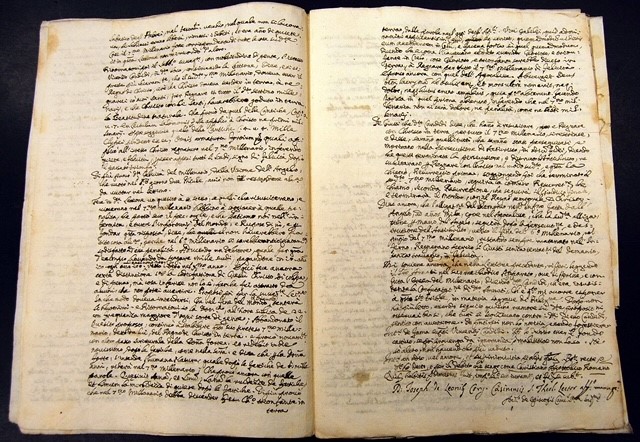
Search medieval and early modern records
Be realistic: ordinary Hebridean families can rarely be traced on paper before the 1700s, and many island Old Parish Registers only begin in the late 1700s or early 1800s. Start with the OPRs, estate rentals, the 1841 census and Gaelic patronymic naming, then use these sources for wider context:
- Saga references (e.g., Hákonar saga Hákonarsonar and Orkneyinga saga)
- Chronicles (Melrose, Man, Lanercost)
- Later clan genealogies
- Land charters and territorial histories
These sources give valuable historical context, though they rarely name ordinary families.
Conclusion: Why Largs Still Matters
The Battle of Largs wasn’t a dramatic clash — but it marked the turning point that ended Norway’s long overlordship of the Western Isles. For genealogists, it closes the four-century era that explains why Norse DNA, surnames, and place‑names remain so strong in the Hebrides and Northern Isles today.
If your family comes from the Hebrides, the Northern Isles, or Scotland’s western seaboard, the legacy of Norse settlement may be woven through your DNA, your surname, or the very place‑names your ancestors lived among. The Battle of Largs was a turning point — and understanding it can help you understand them. If you’d like help exploring possible Norse roots, interpreting DNA results, or tracing families through the Isles’ complex medieval and early‑modern history, I’d be honoured to guide you. Get in touch and let’s uncover the Norse chapter of your Scottish story.
Sources and further reading
- Hákonar saga Hákonarsonar and Orkneyinga saga (both available in English translation)
- R. Andrew McDonald, The Kingdom of the Isles: Scotland’s Western Seaboard c.1100–c.1336 (1997)
- Barbara E. Crawford, Scandinavian Scotland (1987)
- George F. Black, The Surnames of Scotland (1946)
- Gilbert et al., “The genetic landscape of Scotland and the Isles”, PNAS (2019)
- ScotlandsPeople, for Old Parish Registers and census records